Showing posts with label A level law. Show all posts
Showing posts with label A level law. Show all posts
Wednesday, 27 April 2016

Monday, 7 April 2014

Criminal courts and lay people - an overview
Criminal courts, appeal courts and classification of offences
·
100% of criminal cases start in the magistrates
court
·
Magistrates deal with things like bail and legal
aid
·
If the case is triable either way then it will
take place in the Crown court with a judge and a jury
·
If defendant wishes to appeal he would appeal to
Court of Appeal
·
Can appeal against conviction and sentence
OR
·
Can also appeal to the Queen’s Bench Divisional
Court of the High court on a point of law
·
Final appeal is to the Supreme court
Role and powers of lay magistrates
·
Adult court – deal with criminal cases for ages
18+
·
Youth court – hear cases for people ages 10-17
·
Decide on guilt and sentence
·
Deal with bail applications and conditions for
bail
·
Deal with transfer hearings
Advantages of lay magistrates
|
|
Advantage
|
|
Cross section of society
|
Involves
members of community and wide section of society than professional judges
49% of
magistrates are women
|
|
Local knowledge
|
They know
about local events, patterns of crime and local people’s opinions
|
|
Cost
|
Cheaper to
have unpaid magistrate
Cost of
unpaid magistrate is £52.10 per hour and is cheaper than a District judge
which is £61.78
|
|
Few appeals
|
Few
defendants appeal and those that do against are sentenced not guilty
Saves time
|
Tuesday, 24 September 2013

Monday, 19 August 2013
Murder
Lord Coke defined murder as:
"The unlawful killing of a human being under the Queen's Peace with Malice aforethought."
CausationDefendant can only be liable for victims death were their acts are both the factual and legal cause of death;• Nedrick was death or serious injury a virtual certainty as a result of defendants actions? Did the defendant foresee this as in Woolin? If yes, the jury can infer intent.Read the following articles and consider, was there sufficient mens rea for murder? Why was the defendant charged with murder?

Actus reus
This can be either an act or an omission. In most cases an omission doesn't amount to criminal liability, but there are exceptions to this, namely whether the law recognises a duty to act, including:
• For legal causation, there must be more than a slight or trifling link between D’s act/omission and the consequences for the victim and it doesn't need to be the sole cause (Kimsey)
• Defendants actions must be the operative and significant cause of death as in the case of Smith.
It is unlikely negligent medical treatment would break the chain of causation as in Cheshire.
• An intervening act that is reasonably foreseeable will not break the chain of causation such as Blaue (Jehovah’s witness, thin skull test). There are circumstances where an intervening act will break the chain of causation such as in Williams where the victims action was unpredictable and stupid (Daftness test - victim thought the defendant was trying to steal his wallet so he jumped out of moving car and was injured)
Mens rea of murderDefendant must demonstrate the required malice aforethought – the intention to kill or cause really serious harm. Intention has two types;
Indirect/Oblique intent
• Did not desire the outcome but in acting as they did, realised it might occur as in Maloney (intention and nothing less.)
http://news.bbc.co.uk/1/hi/uk/8466140.stm
http://obiterj.blogspot.co.uk/2010/11/r-v-frances-inglis-considerations-far.html
"The unlawful killing of a human being under the Queen's Peace with Malice aforethought."
CausationDefendant can only be liable for victims death were their acts are both the factual and legal cause of death;• Nedrick was death or serious injury a virtual certainty as a result of defendants actions? Did the defendant foresee this as in Woolin? If yes, the jury can infer intent.Read the following articles and consider, was there sufficient mens rea for murder? Why was the defendant charged with murder?

• A foetus in utero (a baby who has not been born and is does not exist separately from its mother) and a person who is brain dead (Malcherek) is not a reasonable creature in being and therefore cannot be murdered.
• Attorney General's Reference (No 3 of 1994)(1997): "Violence towards a foetus which results in harm suffered after the baby has been born alive can give rise to criminal responsibility"
• Under the Queen’s Peace
means not during active war.
This can be either an act or an omission. In most cases an omission doesn't amount to criminal liability, but there are exceptions to this, namely whether the law recognises a duty to act, including:
• A duty arising through relationship
(Gibbins and Proctor)
• A contractual duty
(Pittwood)
• A duty which has been taken
on voluntarily (Stone and Dobinson)
• A duty arising from creating a dangerous situation (Miller)
Factual
•
‘But for’ test as in the case of Pagett. (human
shield)• For legal causation, there must be more than a slight or trifling link between D’s act/omission and the consequences for the victim and it doesn't need to be the sole cause (Kimsey)
• Cato – must be more than a
minimal cause
Legal• Defendants actions must be the operative and significant cause of death as in the case of Smith.
It is unlikely negligent medical treatment would break the chain of causation as in Cheshire.
• An intervening act that is reasonably foreseeable will not break the chain of causation such as Blaue (Jehovah’s witness, thin skull test). There are circumstances where an intervening act will break the chain of causation such as in Williams where the victims action was unpredictable and stupid (Daftness test - victim thought the defendant was trying to steal his wallet so he jumped out of moving car and was injured)
Mens rea of murderDefendant must demonstrate the required malice aforethought – the intention to kill or cause really serious harm. Intention has two types;
Direct intent
•
Must have intended to kill or cause grievous bodily harm. Indirect/Oblique intent
• Did not desire the outcome but in acting as they did, realised it might occur as in Maloney (intention and nothing less.)
http://news.bbc.co.uk/1/hi/uk/8466140.stm
http://obiterj.blogspot.co.uk/2010/11/r-v-frances-inglis-considerations-far.html
Thursday, 15 August 2013
Mens rea

Mens rea is a Latin term referring to the mental element of criminal liability and broadly there are 2 types of mens rea; intention and recklessness.
- It can be either an actual intention to do the particular kind of harm, or
- recklessness whether such harm should occur or not.
Intention is also known as specific intent and can be split into two types:
Direct Intent - the defendant's aim and purpose is to bring about the consequence. He set off on a course of action trying to bring about a certain consequence and that is what occurs.
Direct Intent - the defendant's aim and purpose is to bring about the consequence. He set off on a course of action trying to bring about a certain consequence and that is what occurs.
A police officer signialed the defendant to stop his car. The defendant accelarated towards the police officer who jumped out of the way and the defendant drove off without stopping.
Oblique intent
1.The consequences of the defendant’s actions were virtually certain and
2.the defendant foresaw this.
R v Woollin [1998]
The defendant lost his temper with his three month old son and threw him towards his cot. He missed and the baby hit the wall behind. The baby was badly injured and died as a result.
Serious harm was virtually certain
Recklessness - The defendant realised there was a risk of the result occurring but went ahead The defendant lost his temper with his three month old son and threw him towards his cot. He missed and the baby hit the wall behind. The baby was badly injured and died as a result.
Serious harm was virtually certain
with his actions anyway. (Conscious risk taking or taking an unjustified risk)
R v Cunningham [1957]
The defendant broke into a gas metre to steal the money inside. The gas leaked into the property next door and made the resident ill. D was charged, with having unlawfully and maliciously caused V to take a certain noxious thing, coal gas, so as thereby to endanger her life.
Held: The correct test is whether D foresaw that the removal of the gas meter might cause injury to someone but nevertheless removed it.
Not guilty (on misdirection)
Actus reus
There are three basic elements which must be provided in order to establish criminal liability:
1. guilty conduct (actus reus)
2. a guilty mind (mens rea)
3. absence of any defence.
Actus reus is a Latin phrase meaning the conduct or state of
affairs which a particular offence prohibits. i.e.

The
actus reus is usually, although not always, committed through a voluntary act, taking into account of
the surrounding circumstances, e.g. causing death by dangerous driving. This is
a result crime.
The voluntary nature of the action was discussed in the case of Hill v Baxter (1958) where the court gave examples of where a driver could not to be said to be doing the act of driving voluntarily, these included the driver losing control of the car because they had been attacked by a swarm of bees, being hit on the head by a stone or having a heart attack at the wheel.
There are some rare instances where the defendant has been convicted not because of a voluntary act they have committed, but because of the situation they have found themselves in. This is known as 'state of affairs' cases. An example is the case of Larsonneur (1933) in which the defendant who was a French citizen was deported from Ireland to England. When she arrived in England she was immediately charged with being an illegal entrant and her conviction was upheld on appeal even though she had come to England against her will. She was convicted not because of a positive action on her behalf, but simply because of the situation she found herself in.
In some situation an omission, meaning a failure to act, can constitute the actus reus although this is only in particular circumstances which include the following:
1. Assuming responsibility meaning that reasonable steps need to be taken to care for the individual
R v Stone
& Dobinson
The defendant's voluntarily took on care of an anorexic sister. They did nothing to care for her and didn't call a doctor when it was clear she she was very ill and she died
They were found guilty of
manslaughter because they had volunteered to care for her and then failed to do so.
2. Creating a dangerous situation meaning a legal obligation to take reasonable steps to reduce the danger that you have created.
R v Miller
While the defendant was squatting in a house he accidentally set fire to a mattress with a cigarette
He did nothing to put the fire out and just moved into another room.
He was found guilty of
arson because he failed to do anything about the dangerous situation he had created.
3. Contractual - Legal obligation
to fulfill duty set out in a contract.
R v Pittwood
The defendant was employed (and therefore had a contract of employment) to open and close a gate to vehicles crossing a railway track.
He failed to do this and a cart went on to the track when a train was coming and people were killed
He was found guilty of
manslaughter because he failed to carry
out task given to him.
4. Relationship - Legal obligation
to look after children/partner.
R v Gibbons
& Proctor
The father of a child was found guilty of
murder because he had failed to provide
reasonable care.
5. Where
an act of Parliament expressively states that one will be required to act
Road Traffic
Act 1988
E.g. not wearing
a seatbelt.
E.g. failing to
give a specimen test.
Wednesday, 14 August 2013
The legislative process

Green
|
Green paper
|
Contains the general proposal
|
Winged
|
White paper
|
More detailed proposal are set out after the initial consultations
|
Dragons
|
Draft
|
The proposals are drafted into a bill by government lawyers and then
published
|
Fly
|
First reading
|
The bill is usually introduced to the House of Commons. This merely
notifies the House of the bill and its subject matter. There is no debate.
|
Slowly
|
Second reading
|
This is the main debate on the principles of the bill, followed by a
vote.
|
Clockwise
|
Committee stage
|
A committee between 16 and 50 MPs examines the details of the bill
clause by clause and suggests amendments.
|
Round
|
Report stage
|
The committee reports back these amendments to the House.
|
The
|
Third Reading
|
This usually coincides with the report stage and marks the final
debate on the bill in its amended form in the House of Commons.
|
Old
|
Other house
|
The bill passes to the ‘other house’ (House of Lords) for similar
procedures, although in the committee stage in the lords the whole House acts
as a committee.
|
Ruin
|
Royal assent
|
The Monarch gives approval to the bill. This is a formality and is
not undertaken by the Queen personally.
|
Resources to help you to research the Equality Act 2010 and the Marriage (same sex couples) bill
Equality Act 2010
The text of the Equality Act 2010
You may be surprised as to what is included in the Equality Act.
The Citizens Advice Bureau publishes guidance as to your rights under the Equality Act, it's worth reading to ensure you know your rights and you know what to do if you think that your rights have been breached.
Marriage (same sex couples) bill
Information from Parliament about the journey from a bill to an act
BBC Q&A on gay marriage including the arguments for and against
Lord Tebbit argues that Gay marriage bill may lead to "lesbian queen and artificially inseminated heir"
Gay couple to sue the Church of England over their refusal to conduct same sex marriages.
The text of the Equality Act 2010
You may be surprised as to what is included in the Equality Act.
The Citizens Advice Bureau publishes guidance as to your rights under the Equality Act, it's worth reading to ensure you know your rights and you know what to do if you think that your rights have been breached.
Marriage (same sex couples) bill
Information from Parliament about the journey from a bill to an act
BBC Q&A on gay marriage including the arguments for and against
Lord Tebbit argues that Gay marriage bill may lead to "lesbian queen and artificially inseminated heir"
Gay couple to sue the Church of England over their refusal to conduct same sex marriages.
Doctrine of Parliamentary Supremacy
As a democratically elected body, parliament is the supreme law making body in the UK.


Parliament can legislate on any subject matter, meaning there are no limits on what they can make laws about. An example of this is the Parliament Acts 1911 and 1949 which limited the powers of the House of Lords to block a Bill by voting against it.
Parliament cannot bind their sucessor, meaning each new Parliament should be free to make or change what laws they wish. There are some laws which cannot be repealed, e.g. Act of Settlement in 1700 changed the line of sucession to the throne. It affected who was entitled to be King or Queen so after 300 years this could not be repealed.
Laws made by Parliament cannot be overruled by others, even where the Act of Parliament may have been made because of incorrect information. See the case of British Railways Board v Pickin.
One limitation to Parliamentary supremacy is the membership of the European Union. The UK joined the European Union in 1973 by passing the European Communities Act 1972, this membership means that European Union law takes priority over English Law. e,g, Merchant Shipping Act 1988 states that 75% of directors and shareholders in certain businesses had to be British , this contradicted EU law and there was changed as discussed in the Factortame case.
The rule of law
 |
| A. V. Dicey |
In 1885, the first edition of A.V. Dicey's An
Introduction to the Study of Law of the Constitution was published. This
book became one of the most influential works of authority on the British
constitution. Dicey described the rule of law as one of the 'twin pillars' of
the constitution (the other being parliamentary sovereignty) . He saw the rule
(or supremacy) of law as the ultimate source of authority to which all,
including the institutions of the state are subject. According to Dicey, rule
of law has three main elements:
1. Nobody should be punished unless they have
broken the law.
2. The same laws should apply to officials of
the state just as to the ordinary people.
3. The rights of the individual do not stem
from decisions made by the executive
(government), but from judgments made in individual cases by individual judges.
The separation of powers

The theory of the separation of powers was first
put forward by Montesquieu, a French political theorist in the 18th
century. The theory states that there
are 3 functions of the state:
- The Executive (government) have strict authority and responsibility to administer the law.
- The Legislative (parliament) make the laws and are also authorised to raise taxes and other money bills.
- The Judiciary (the judges) apply the law
Why should they be separate?
- To stop one arm from gaining absolute power and abusing the power they are given.
- To allow each arm to become more specialised.
- To stop bias decisions being made (e.g. if a judge makes a law and then tries a case dealing with this law, he may make the wrong decision because of the opinion that has already been made.
The UK constitution...?
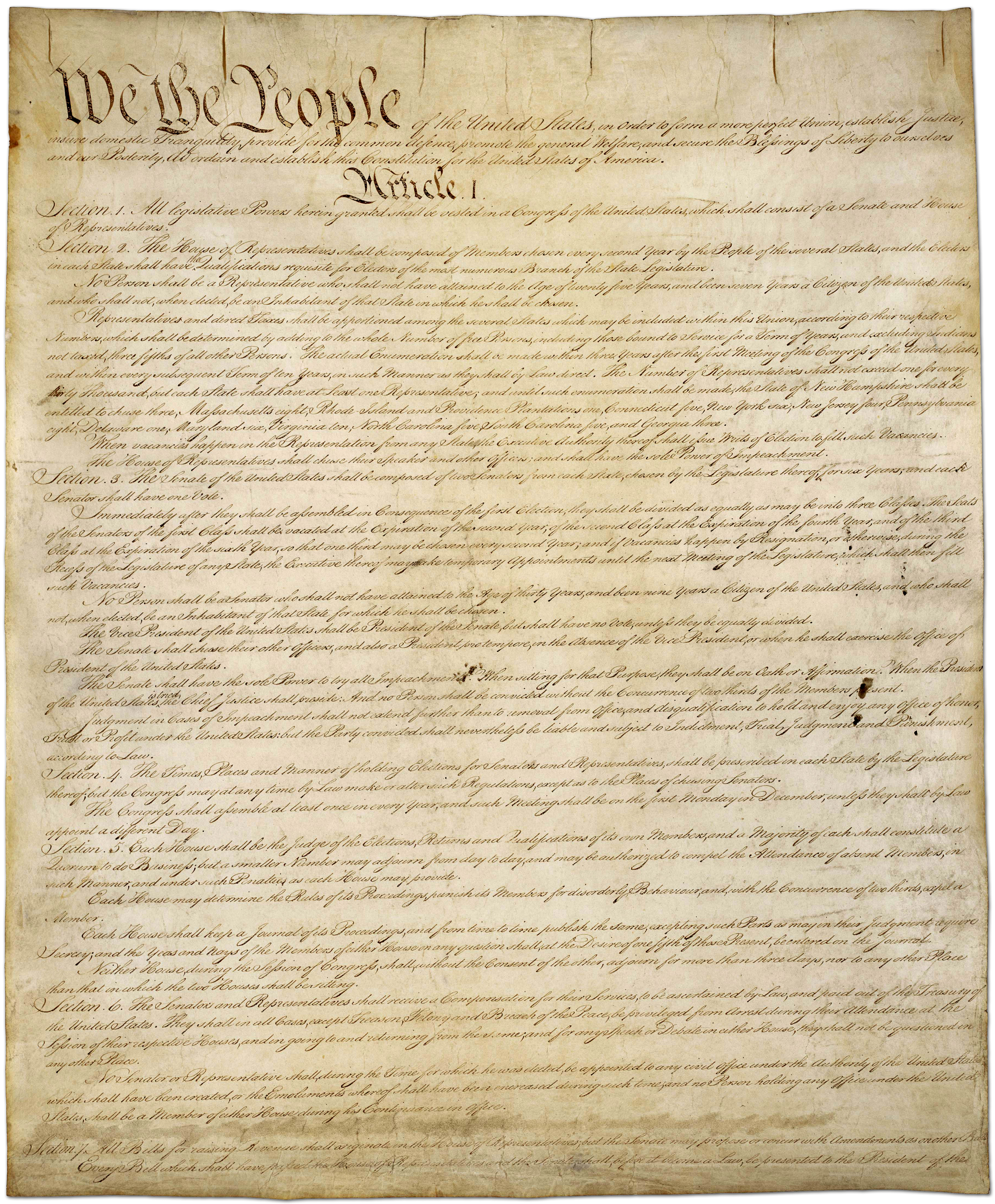 Many countries have a document called the constitution. It is a document which describes:
- the powers the government has in a state
- the relationship between different parts of the state
- the relationship between government and the citizen
Probably the most familiar to us is the American constitution which you can read about here.
In the UK we don't have a document called the constitution but does this mean we don't have a constitution?
The US constitution is codified which means that the contents is collected together and collected in one place. The UK does have a constitution but it is not codified because it has never been collected together and written down in one document, it's all over the place.
An example of an early form of the British constitution is the Magna Carta in 1215. This was one of Britain's first steps to democracy because it set up a committee of 25 barons at any time overrule the will of the king if he defied the charter (Clause 61) and created the law that no freeman can be punished except through the law of the land.
There are lots of other sources of the UK constitution including:
- Statute law - Acts of Parliament that are constitutional
- Common law - Based on past customs and precedence (when Judges interpret laws and further legal cases use that interpretation) i.e the law has evolved
- Conventions - Unwritten rules that are followed
- Works of constitutional authority - Books about the government which help to interpret the law
- EU laws and treaties - Laws made by the EU that overrule UK law
So, should it be written in one easy to read document?
Some would argue that interpretation of the law would be more precise if there was a document to refer to (see the Factortame case) and our membership of the European Community has made things a little confusing. A written document would also make it harder for the leading party to change the laws in their favour; it would reduce 'elective dictatorship'.
However, the primary reason for a country to create a written constitution is they have undergone a major change such as a war or a revolution, the UK has not gone through such a massive change (arguably since 1066) and therefore our system has evolved as we have and continues to change with us.
Subscribe to:
Posts (Atom)